
A Victorian schoolmaster did not reach for whatever was to hand. He reached for a specific object, bought from a specific supplier, kept in a specific place, and used according to rules that varied by country, by sex of the child, and by the part of the body it was meant to strike. The implements of nineteenth-century discipline were manufactured goods with standards and price lists, and the differences between them are the clearest window we have into how the period actually thought about punishment.
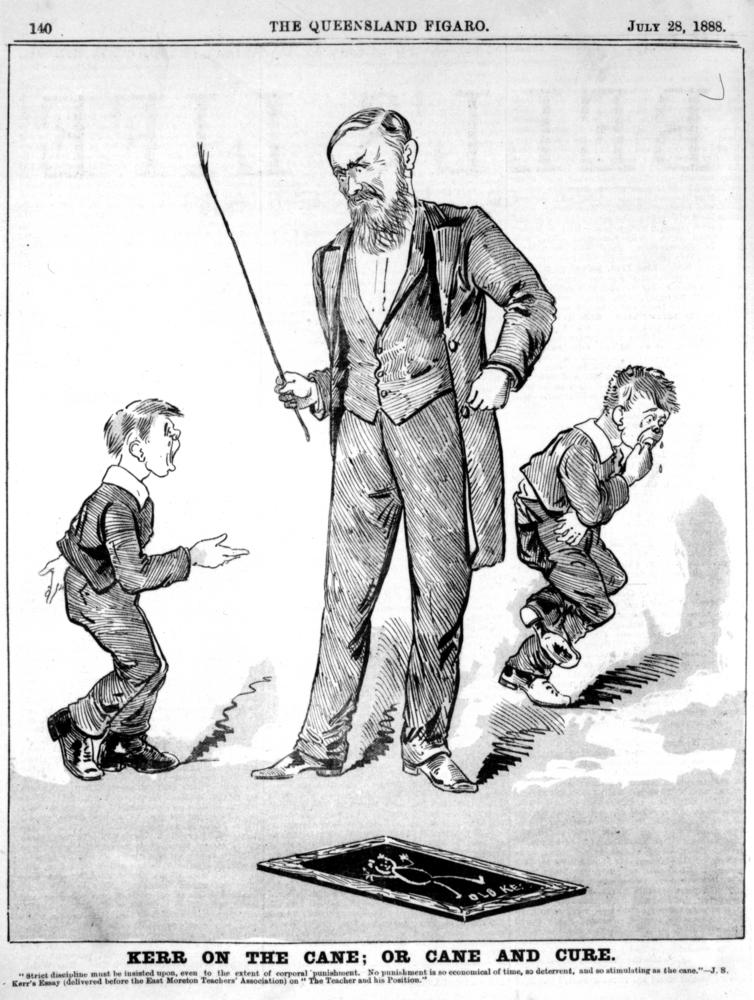
The cane
The classroom cane was not made of English wood. It was rattan or bamboo, imported, chosen because it flexes without splintering: roughly one centimetre in diameter and about a metre long. That combination is what made it the dominant implement of the second half of the century. A wooden ruler bruises and can break a bone; a rattan cane stings ferociously and leaves marks that fade.
Where it landed was governed by convention rather than law. Boys were caned on the backside or on the hands. Girls were usually caned on the hands or the backs of the legs. The standard sentence was three or six strokes, which is the origin of the phrase six of the best. Teachers were also expected to spare the writing hand, since a boy who could not hold a pen was of no use for the rest of the day.
The birch
The birch was a different class of object altogether, and the name misleads. A birch rod is not a rod at all but a bundle of leafless twigs bound together at one end, and it was not necessarily made of birch. Willow was common. Hazel was preferred for judicial use precisely because it hurt more.
Size decided severity, and different institutions kept different sizes. Schools used the smaller pattern, sometimes called the Eton birch. The Royal Navy went further and standardised: each major dockyard held a patterned birch against which others were measured. At Dartmoor Prison the version reserved for offenders over sixteen weighed about 450 grams and measured 1.2 metres.
One change in the 1860s says a great deal about class. The Royal Navy stopped flogging its boy sailors with the cat o nine tails and switched to the birch. The reasoning was not humanitarian in any modern sense: the birch was the implement the officer class had themselves met at school, and it was therefore the familiar and respectable one.
The tawse
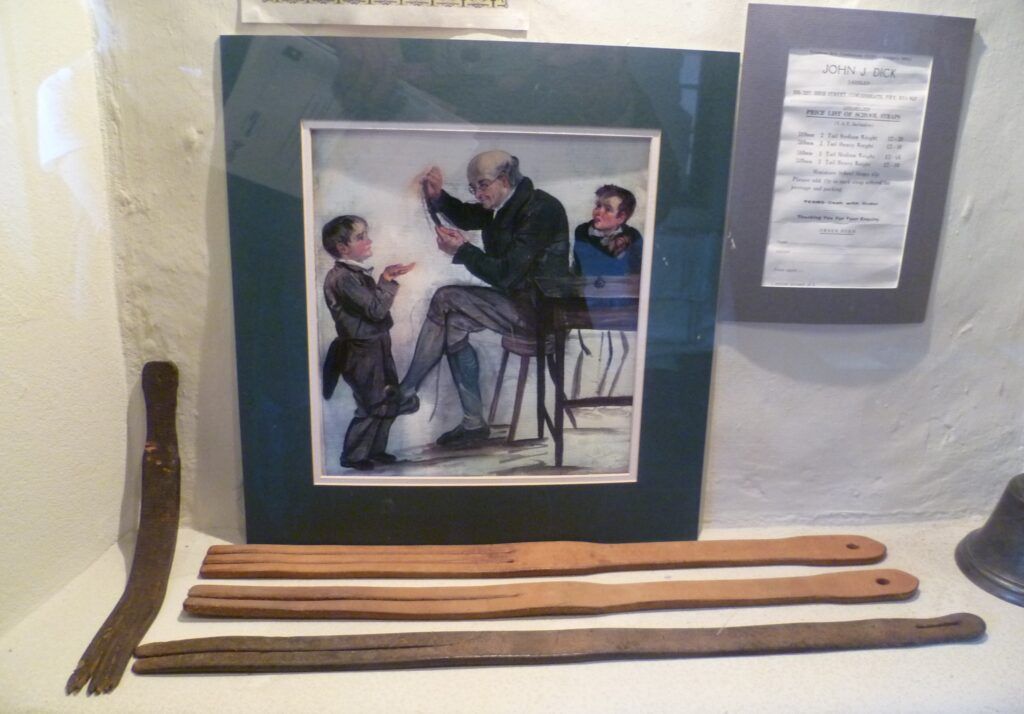
Scotland went its own way. The tawse is a thick leather strap with the far end split into two or more tails, and it was applied to the outstretched palm. That last detail matters: a Scottish child held out a hand and was expected to keep it steady, which made the punishment a public test of composure in a way that caning across the desk was not.
It was not exclusively Scottish. Newcastle, Gateshead, Liverpool, Manchester and Walsall all used it, and in Walsall, Gateshead and parts of Manchester and Nottingham it was applied to the buttocks instead of the hand. It was used on girls as well as boys.
The tawse is also the one implement with a famous maker. John J. Dick Leather Goods, of Lochgelly in Fife, is estimated to have produced around seventy per cent of the tawses in British schools. The Lochgelly strap was a brand.
The American switch
The United States had no equivalent of the imported rattan trade and no national standard. The historian Judith Kafka records that American teachers commonly reached for a switch cut from a tree, a length of cowhide, or a wooden ruler. Children were also made to kneel on sharp objects or stand motionless for long stretches, punishments that left no mark at all.
The legal footing was the doctrine of in loco parentis: the teacher stood in the place of the parent and inherited the parent right to correct. That single principle is why American school discipline of the period was argued in terms of parental authority rather than state power, and why it survived so long.
It was contested at the time. Horace Mann, the most influential education reformer of the American nineteenth century, called corporal punishment a relic of barbarism. He did not win the argument in his lifetime.
What the punishment book recorded
British schools were required to write it down. Only the headmaster or headmistress could administer the punishment, and each instance went into the school punishment book. Those books survive, and they are far more revealing than any account written for publication, because they were never meant to be read by outsiders.
The Hitchin British Schools records give the flavour. In 1900 a boy was caught smoking and the master noted that he took from him three cigarettes which I burnt. Around the same year a truant received four strokes of the cane, after a previous warning. In 1912 six girls were excluded from school on account of unclean state of hair.
Note what is being recorded: not cruelty and not remorse, but administration. Number of strokes, offence, whether a warning had been given first. The book exists because the punishment was supposed to be bounded and accountable.
The punishments that left no marks
Not everything in the Victorian classroom was an implement. The dunce cap was a cone of rolled newspaper, sometimes finished with a badge or armband, worn while sitting in the corner. Lines meant writing the same sentence up to a hundred times, and the handwriting had to be faultless or it did not count. Detention kept a child after hours, either standing still or set to sewing or cleaning.
These were shame punishments and time punishments, and they sat alongside the cane rather than replacing it. A school that used the dunce cap almost certainly also owned a cane.
How it ended
Not all at once, and not in the order most people assume. Judicial birching of both juveniles and adults was abolished in Britain in 1948. It survived in prisons as a punishment for serious offences until 1962. The Isle of Man kept it until 1976, which produced an international controversy the British government could have done without.
Schools outlasted the courts by decades. It took a 1982 ruling of the European Court of Human Rights before corporal punishment was banned in British state schools in 1987, more than a century after the cane became standard equipment.
Why the objects matter
Read the implements rather than the rhetoric and the period looks different. A society that standardises a birch and keeps a master copy at every dockyard is not lashing out; it is administering. A country that splits into cane counties and tawse counties has local custom doing the work that national law is not. And a punishment book that records the number of strokes alongside the offence is a document written by someone who expected to be held to a limit.
None of that makes it defensible. It does explain why it took so long to end: the practice was not experienced as violence by the people carrying it out. It was experienced as procedure.